Recently been hospitalised following a heart scare that rather put a dampener on active photography. However it did give me a chance to read the above book [Thames and Hudson 1981]. The book illustrates the problems faced by anyone who attempts to explain the history of photography by selecting those photographers who are seen to represent a particular area of photography or a particular approach or even trying to place a photographer as being of a particular type. There necessarily has to be a selection that supports the view that is being put forward and, by definition, selection ignores/rejects other examples of a particular photographer's work that don't quite fit.
Photography is subjective and selective from the start. What is 'seen' and photographed and what is excluded is solely at the discretion of the photographer even where there is an agreed assignment. What is submitted for publication is a further selection and what is published is a final selection. To emphasise this selective process what is seen and understood by the viewer may be far from that intended originally. For example on p 183 of the book there is the image by Kersetz of his entitled "On the Quais Paris" that was published in Day of Paris (New York 1945).For me it is a simple composition that illustrates the difference in the style of dress between the man in the bowler hat and the two men walking towards us in flat caps. I do not 'see' any fear in the man with the bowler hat at the approach of the other two men and yet in the narrative the author writes
"Some of his subjects are prey to passing fears: a bowler-hatted gent grasps a stout stick behind his back against two approaching cloth caps on a Paris quai in 1926." [ p 182]
Either interpretation or hundreds of others may be correct but the narrative suggests that the author makes his interpretation purely on his view of class - the bowler-hatted man is a "gent" but the other two men are just "cloth caps"as though they are of a sub-human species that are prone to attacking others. From this observation he reaches the conclusion that some of the subjects of Kersetz's photography are prey to a passing fear. The reader is guided towards a particular view that, I would, suggest, is poorly supported.
I found the book uneven in its approach and was more indicative of the author's views than an objective study of the history of photography. It was an interesting insight into the thinking of the author but I am not sure why I needed to know that.
Monday, 27 February 2012

Wednesday, 8 February 2012
Project 25 - Snow
Although it was a clear day there was an overcast sky so very little variation in the light. However i decided to take the shots anyway because it was a valuable learning experience plus I needed some winter shots for the portfolio images.
As suggested I set exposure compensation at +1.5. Interestingly when developing the RAW images and using 'Auto' exposure to establish a starting point almost without exception the result was between -1.2 and -1.5 suggesting the exposure compensation was not necessary. Certainly I had to make few changes to the exposure settings. I found that the snow had a slight blue tinge that was noticeable on close examination. I altered this by reducing the saturation of the blues using Lightroom. It seemed to work successfully.
The following are examples of the images taken:


As suggested I set exposure compensation at +1.5. Interestingly when developing the RAW images and using 'Auto' exposure to establish a starting point almost without exception the result was between -1.2 and -1.5 suggesting the exposure compensation was not necessary. Certainly I had to make few changes to the exposure settings. I found that the snow had a slight blue tinge that was noticeable on close examination. I altered this by reducing the saturation of the blues using Lightroom. It seemed to work successfully.
The following are examples of the images taken:


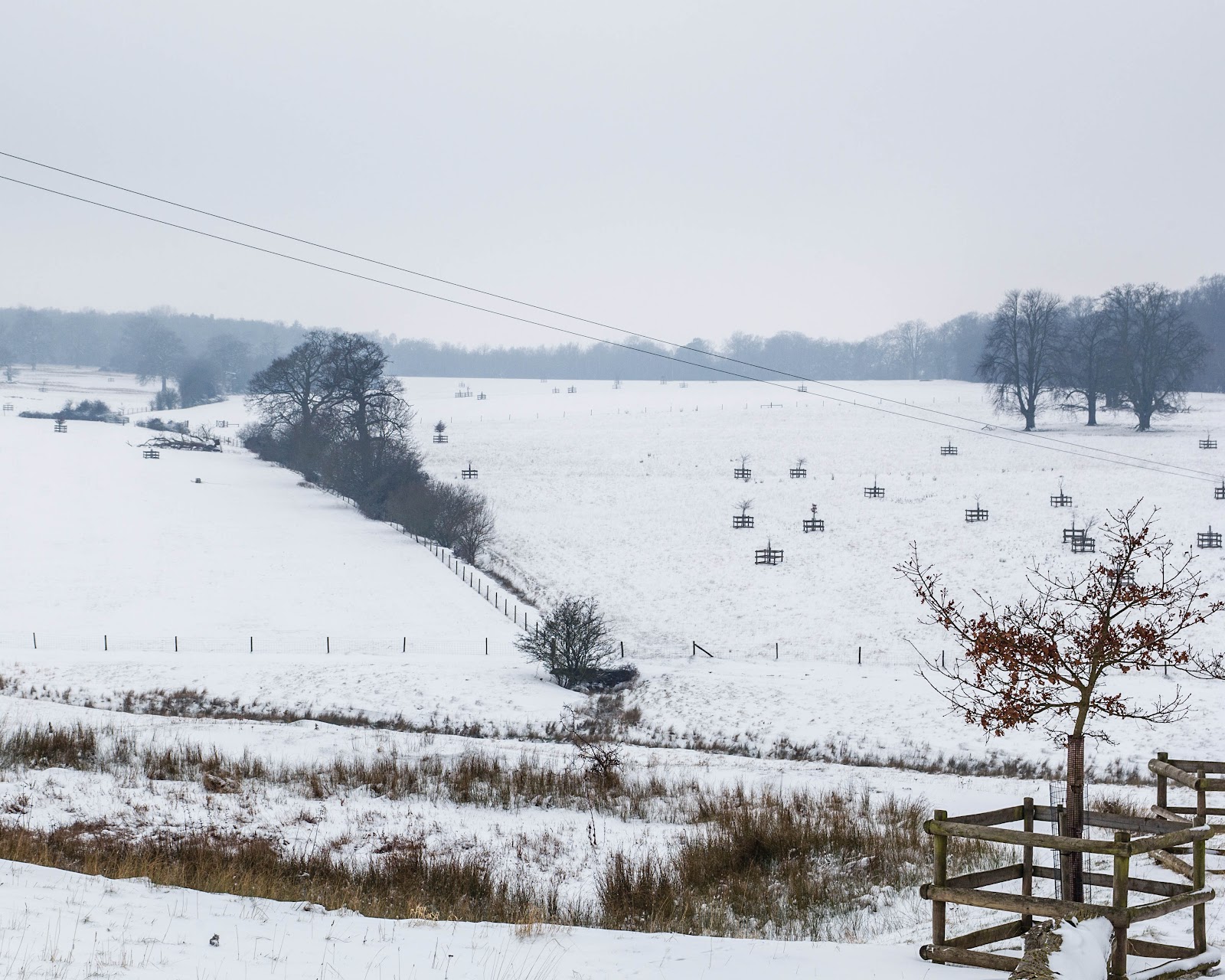
I took many more but will be using those for the winter shots for both Assignment 1 and Project 15 portfolio work.
As I said above it was an overcast day but two days later the sun shone so I include two additional shots showing the effect of sunlight. and shadows.


In the first of these two there is a bluish tinge in the shadows that is not unattractive.
As stated in the Course material the chances of snow in this Country particularly in East Anglia is small. The lessons learnt from this exercise (apart from how tiring it is trudging through 4 inches of fresh snow carrying a tripod and camera) were the delights of such photography and the sculpting effect of snow fall
on trees and shrubbery. In technical terms the advice on exposure compensation has to be approached with some caution although why this is the case is less clear to me. Fortunately I invariably shoot RAW so I have opportunity to adjust the exposure later. Although on the day the lack of sunshine made the exploration of the effect of varying light not possible in the main I was able to do so later in the week.
Sunday, 5 February 2012
Winter weather
Be careful what you wish for - someone may grant your wish. Woke up to 4" of snow which made the journey to the site where I had taken my autumn shots interesting to say the least. However it was well worth it. What was most noticeable was the way that the snow created fascinating patterns and sculptures where before there had only been the blandness of trees and shrubbery that lacked colour or differentiation. Lost myself in the delight of taking images in what can only be described a s winter wonderland. One of those days that makes photography so worthwhile.
Thursday, 2 February 2012
Assignment 1 - Winter
Went out yesterday with the intention of taking the 'winter' series. Unfortunately there is little real evidence of winter and there is evidence of Spring. Hopefully the forecast of wintry conditions over the next seven days may rescue the situation.
It does raise an interesting question of what exactly does represent winter in photography. A very sharp air frost or freezing fog would help and of course a deep ground frost. Similarly with snow. However our present warmer than average winter just leaves leafless trees that changes the view but is not representative of winter as the rest of the landscape looks much the same. The requirement to take photographs of the same area chosen in Assignment 1 does impose restrictions particularly in an area that does not normally suffer from wintry conditions. In the 18 years I have lived in the area I can remember only a few 'winters'.
Fingers crossed or I may have to wait for another winter or beg indulgence and re-shoot Assignment 1.
It does raise an interesting question of what exactly does represent winter in photography. A very sharp air frost or freezing fog would help and of course a deep ground frost. Similarly with snow. However our present warmer than average winter just leaves leafless trees that changes the view but is not representative of winter as the rest of the landscape looks much the same. The requirement to take photographs of the same area chosen in Assignment 1 does impose restrictions particularly in an area that does not normally suffer from wintry conditions. In the 18 years I have lived in the area I can remember only a few 'winters'.
Fingers crossed or I may have to wait for another winter or beg indulgence and re-shoot Assignment 1.
Tuesday, 24 January 2012
Post Processing for Assignment 2
Having downloaded all the images that I took the other day and discarded those that had not worked out as I hoped (about 40%) I began work on changing them from Camera RAW to the finished product. It so happened that at the same time I received notification about the release of Lightroom 4 beta version so I decided to try it out using the images from the shoot (well copies anyway given that it is a beta version). I found it very good not least the shadow and highlight sliders that now only affect that particular part of the image. It negated the need to create 3 images at different exposure levels to capture the best of the tones available as virtually the same effect could be created in Lightroom 4. I do not know if the grunge effects at the extremes of HDR could be achieved but as that was not my aim, I was looking for a photorealistic result, it does not matter to me at this stage.
One problem I came across was transferring the images across to Photoshop (seems to be that this is becoming less and less necessary for many images. Using the given shortcut or the menu version produced an image that had none of the enhancements from Camera Raw (ACR). Using the Adobe forum I discovered that the current version of ACR in Photoshop (6.x.x.) cannot read the Lightroom 4 code hence the lack of changes. ACR 7, that will resolve this problem, has yet to be released by Adobe. The workaround is to 'export' the image to Photoshop. It is exported as a jpeg but that has not proved too much of a problem.
Overall I am quite pleased with the results both of the shoot and the post enhancement. I have reduced the saturation to see if that produces a better overall effect. Although it is a matter of taste I think that the change is for the better. I also have reduced dramatically the amount of sharpening applied at the finish and I think, with this particular set of pictures, it has given a much better result. I have yet to finalise the images I want to submit and am also considering trying one or two black and whites.
I have also re-examined those images with which I was unhappy (learn from one's 'mistakes'). Some failures were for obvious reasons such as very bad lens flare or shots where the brightness of the sun washed everything out because the camera was pointing almost directly at a sun low in the sky. Others were images that were very similar to another one but where the overall composition was not quite so good. some more difficult to decide was where the image did not match my memory of what I taken. A common failure was lack of contrast i.e. a flatness that was unappealing. Of course these may have benefited from work in computer but they lacked any real interest point that made them worth working on.
One problem I came across was transferring the images across to Photoshop (seems to be that this is becoming less and less necessary for many images. Using the given shortcut or the menu version produced an image that had none of the enhancements from Camera Raw (ACR). Using the Adobe forum I discovered that the current version of ACR in Photoshop (6.x.x.) cannot read the Lightroom 4 code hence the lack of changes. ACR 7, that will resolve this problem, has yet to be released by Adobe. The workaround is to 'export' the image to Photoshop. It is exported as a jpeg but that has not proved too much of a problem.
Overall I am quite pleased with the results both of the shoot and the post enhancement. I have reduced the saturation to see if that produces a better overall effect. Although it is a matter of taste I think that the change is for the better. I also have reduced dramatically the amount of sharpening applied at the finish and I think, with this particular set of pictures, it has given a much better result. I have yet to finalise the images I want to submit and am also considering trying one or two black and whites.
I have also re-examined those images with which I was unhappy (learn from one's 'mistakes'). Some failures were for obvious reasons such as very bad lens flare or shots where the brightness of the sun washed everything out because the camera was pointing almost directly at a sun low in the sky. Others were images that were very similar to another one but where the overall composition was not quite so good. some more difficult to decide was where the image did not match my memory of what I taken. A common failure was lack of contrast i.e. a flatness that was unappealing. Of course these may have benefited from work in computer but they lacked any real interest point that made them worth working on.
Tuesday, 17 January 2012
A day out
Spent all of yesterday photographing. Wonderful light with crisp clean air and an almost cloudless sky that meant the light remained constant. Working on the material for assignment 2 - photographing an acre. Went to Wicken Fen that is about an hours drive away as I know the area reasonably well and it offers a range of opportunities.
Decided I would try two things - (a) every shot using a tripod and remote control shutter release and (b) bracketing exposures with a view to either combining the images using hdr or choosing the best outcome. (a) worked o.k. mainly because it is something I have been trying to do for some time. Too often I have allowed the thought of carrying the tripod and setting it up as an inconvenience or an unnecessary burden whilst knowing that the results when I use a tripod are always better than the hand held shots. At first glance the effort was worthwhile.
(b) Made a right mess of this. Successfully set the camera to take multi-shots, changed the necessary settings for bracketed exposures but then FORGOT to press 'Set'. How dumb is that! It is not as though this is new to me. Stupidly I did not check after the first couple of shots to check that things were working. I assumed because the camera clicked three times all was well. Hopefully I will remember next time to check and then check again. Am thinking of the possibility of taking the three images amend two of the exposures in Camera RAW and try photomerge to see what comes out.
Decided I would try two things - (a) every shot using a tripod and remote control shutter release and (b) bracketing exposures with a view to either combining the images using hdr or choosing the best outcome. (a) worked o.k. mainly because it is something I have been trying to do for some time. Too often I have allowed the thought of carrying the tripod and setting it up as an inconvenience or an unnecessary burden whilst knowing that the results when I use a tripod are always better than the hand held shots. At first glance the effort was worthwhile.
(b) Made a right mess of this. Successfully set the camera to take multi-shots, changed the necessary settings for bracketed exposures but then FORGOT to press 'Set'. How dumb is that! It is not as though this is new to me. Stupidly I did not check after the first couple of shots to check that things were working. I assumed because the camera clicked three times all was well. Hopefully I will remember next time to check and then check again. Am thinking of the possibility of taking the three images amend two of the exposures in Camera RAW and try photomerge to see what comes out.
Friday, 6 January 2012
Landscape 2 - Project 21 Silhouette and Reflections
I combined this project with Project 20 (see previous blog) although in this case I used a 50mm prime lens for the shot. The aperture was set at f22 and I used a shutter speed of 1/8000.


The sun 'star' is a good one and the silhouette of the pier retains definition as can be seen by the silhouetted figures along the pier. The reflected light on the water leads the eye into the picture and encourages the viewer to follow the line of the pier.
I gave consideration to selectively lightening the image in Photoshop but took the personal view that there was more drama created by the difference between the 'star' and the sky and the dark of the pier structure. It could also be argued that the reflection is 'chopped off' too soon and the image would benefit from having been taken further back.
Subscribe to:
Posts (Atom)