Again on the advice of my tutor I have spent some time looking at the photographs of Robert Adams. I found that I was more in sympathy with his style. Although there is a simplicity about his style of landscape photography I was still left with the feeling that he had applied most of the 'rules' about photography that we, as amateurs, so slavishly follow. There is evidence that some thought has been given to the composition and the overall impact of the image. There is a message that is discernible particularly when several linked images are seen one after the other. There is also a sense of the photographer wanting to present the best image that he can achieve from the view in front of him.
His use of light, including artificial light such as that given by street lamps, is shown at its best in his twilight series that is held by the V&A Museum. (http://www.vam.ac.uk/content/articles/p/photographs-by-robert-adams/.) I particularly liked this set of images that evoked in me a wish to see further into the image (what is beyond what is shown!).
I preferred this style to the starker imagery of Aarmson as discussed in my last blog.
Thursday, 5 April 2012

Hans Aarsman
Following a comment by my tutor in his response to my submission for Assignment 2 of Landscapes I followed up his suggestion that I look at the work of Hans Aarsman a known photographer in the genre called Neo-Topographics. At first I looked at the photographs shown on the Nederlandfotomuseum. I was immediately struck by their lack of artistic merit. They are snapshots of a man made environment usually incomplete or in decay. I was left wondering why he had bothered taking the shot. As a record of the environment I felt that there was a sense of detachment almost disinterest in what was seen through the viewfinder. They were very ordinary.
I then watched a recording of a lecture by Aarsman in which he explains the reasons for his approach. All my responses were more or less in line with the aim of the photographer. Following the work of the New Topographic Photographers such as Robert Adams, Lewis Baltz and others Aarsman and his contemporaries deliberately chose to work outside the accepted 'artistic' and story telling approach of photography, they eschewed the beauty and recorded the ugly. Based on the images I have seen of Aarsman he was very successful.
Even now I am not sure that I like them but it has made me think that I, as a photographer, am very much conditioned by the majority who seek out the artistic, the emotional and the beautiful image. The chances of such images being accepted in a general exhibition are small perhaps because we do not like to be reminded that not all is beauty and that some of our environment is very ugly and often such ugliness is created by man.
At least I will look afresh at the 'landscape' and see beyond the accepted coffee table book image.
I then watched a recording of a lecture by Aarsman in which he explains the reasons for his approach. All my responses were more or less in line with the aim of the photographer. Following the work of the New Topographic Photographers such as Robert Adams, Lewis Baltz and others Aarsman and his contemporaries deliberately chose to work outside the accepted 'artistic' and story telling approach of photography, they eschewed the beauty and recorded the ugly. Based on the images I have seen of Aarsman he was very successful.
Even now I am not sure that I like them but it has made me think that I, as a photographer, am very much conditioned by the majority who seek out the artistic, the emotional and the beautiful image. The chances of such images being accepted in a general exhibition are small perhaps because we do not like to be reminded that not all is beauty and that some of our environment is very ugly and often such ugliness is created by man.
At least I will look afresh at the 'landscape' and see beyond the accepted coffee table book image.
Friday, 30 March 2012
Newcastle Life - 1880
Just seen the photographs on the centre spread of the Guardian (Friday 20th March 2012). Of working class people they are stunning in their clarity and in the story that they tell. The main image of the Cloth Market is full of detail and remarkable clarity. When one thinks of the equipment that was available at that time obviously whoever the photographer was he/she was a master of the art.
Wednesday, 28 March 2012
Television and Photography
Have been watching the series by John Sergeant - Britain's First Photo Album in which he tried to capture the essence of the work of Francis Frith. The Frith photographs, which were taken by a team of photographers under the leadership of Frith, are outstanding allowing for the difficulties faced by the photographers in the late 19th Century. There is something quite magical about them seemingly capturing the atmosphere which takes the photographs out of the ordinary. In part it is the attraction of seeing places that you know as they were over 100 years ago but also the skill of the photographer in the way that the image is composed and presented. Such ability can be learnt but one wonders how long it is before the necessary thought processes become second nature.
The disappointment, for me, was the attempts by Sergeant. He decided, sometimes for good reason, not to take the 'same' image but tried to capture the same spirit. In nearly all cases he failed and his work suffered from the immediate comparison with his forebears. In some cases his work were little more than snapshots and poorly composed although he seemed pleased with them. This may be because, as common with all photographers, he remembered the emotions he felt at the time of taking the image rather than assessing the result in the cold light of day.
For me the attraction of the series was the work of Frith.
I also watched the David Suchet programme "People I have Shot". Here Suchet was following in the footsteps of his maternal grandfather Jarche. He was a press photographer who covered most aspects of that particular discipline and the majority of his work would now be seen as part of the genre 'Social Documentary' although that is to pigeon hole work that crossed several artificial boundaries. I am not good with people and find social documentary photography difficult so seeing the work of someone who appeared totally at home in this type of work was a valuable opportunity.
Suchet also followed in his grandfather's footsteps indeed using a camera given to him by his grandfather. For me Suchet's work in many respects matched that of his more illustrious relative and clearly he has a talent for putting people at ease and getting the best shots. Maybe this has something to do with his own fame as a well known actor and he gained access that perhaps would have been denied to others. Whatever the reason he provided an excellent programme that provided an insight into the work of his grandfather and his own talent.
I thought that this was a very good programme from which I gained a great deal. I may still be unprepared to undertake social documentary work but at least now I know awhat can be achieved.
The disappointment, for me, was the attempts by Sergeant. He decided, sometimes for good reason, not to take the 'same' image but tried to capture the same spirit. In nearly all cases he failed and his work suffered from the immediate comparison with his forebears. In some cases his work were little more than snapshots and poorly composed although he seemed pleased with them. This may be because, as common with all photographers, he remembered the emotions he felt at the time of taking the image rather than assessing the result in the cold light of day.
For me the attraction of the series was the work of Frith.
I also watched the David Suchet programme "People I have Shot". Here Suchet was following in the footsteps of his maternal grandfather Jarche. He was a press photographer who covered most aspects of that particular discipline and the majority of his work would now be seen as part of the genre 'Social Documentary' although that is to pigeon hole work that crossed several artificial boundaries. I am not good with people and find social documentary photography difficult so seeing the work of someone who appeared totally at home in this type of work was a valuable opportunity.
Suchet also followed in his grandfather's footsteps indeed using a camera given to him by his grandfather. For me Suchet's work in many respects matched that of his more illustrious relative and clearly he has a talent for putting people at ease and getting the best shots. Maybe this has something to do with his own fame as a well known actor and he gained access that perhaps would have been denied to others. Whatever the reason he provided an excellent programme that provided an insight into the work of his grandfather and his own talent.
I thought that this was a very good programme from which I gained a great deal. I may still be unprepared to undertake social documentary work but at least now I know awhat can be achieved.
Tuesday, 6 March 2012
Project 23 - Soft Light
Back to active photography. Spent a day in the Peak District in the Matlock/Bakewell area that I have known for many years both as a child and an adult. The advantage of knowing an area is that you can make a fairly good guess where the conditions that you want can be found. In this case round the village of Stanton in the Peak.
The weather was pretty good with the wintry sun being shrouded by wispy clouds so that the overall contrast in the image was low but at the same time there was an interesting sky that added to the final results. All images were taken with the sunlight coming over my shoulder which allowed for the depth of blue in the sky. Worked the images in Lightroom 4 beta version so as to get the best result possible which I assumed was the purpose of the project. Had the sky been covered completely in cloud then I would have taken the image to reduce the amount of sky in the image but worked on the remainder to again get the best result.


The weather was pretty good with the wintry sun being shrouded by wispy clouds so that the overall contrast in the image was low but at the same time there was an interesting sky that added to the final results. All images were taken with the sunlight coming over my shoulder which allowed for the depth of blue in the sky. Worked the images in Lightroom 4 beta version so as to get the best result possible which I assumed was the purpose of the project. Had the sky been covered completely in cloud then I would have taken the image to reduce the amount of sky in the image but worked on the remainder to again get the best result.

The attraction of this image was the farm cottages together with gardens in the left foreground with the gap in between those and the trees on the right leading the eye into the picture towards the distant hills. The cloud formation adds further interest.

The pattern of the stone walls was the part of the image that caught my eye. The copse of trees on top of the hill balance the farmstead right centre of the image. It was a deliberate choice to include the barbed wire fence at the bottom of the picture to provide the viewer with a sense of scale whilst at the same time to make the viewer aware that the land is private and man-made.
Here I have used the two stone pillars that presumably supported a gate at some time to encourage the viewer to again look into the image both to the mid-horizon where the trees offer a sense of distance between them and the distant hills. I tried the image both as it is shown but also bringing the base of the wall to the bottom of the picture. I chose the former because the rutted track is in contrast to the apparent smoothness of the fields beyond. Although no human being can be seen in the image the presence of man is strongly indicated by the ruts made by a tractor and the structure of the stone wall.
I enjoyed this project although I was fortunate to have some variation in light as different cloud covered the sun. Had this not been the case I feel that the structures either man-made or natural that gave pattern and interest to the images would have been sufficiently strong to still get satisfactory results.
Monday, 27 February 2012
Ian Jeffrey - PHOTOGRAPHY A Concise History
Recently been hospitalised following a heart scare that rather put a dampener on active photography. However it did give me a chance to read the above book [Thames and Hudson 1981]. The book illustrates the problems faced by anyone who attempts to explain the history of photography by selecting those photographers who are seen to represent a particular area of photography or a particular approach or even trying to place a photographer as being of a particular type. There necessarily has to be a selection that supports the view that is being put forward and, by definition, selection ignores/rejects other examples of a particular photographer's work that don't quite fit.
Photography is subjective and selective from the start. What is 'seen' and photographed and what is excluded is solely at the discretion of the photographer even where there is an agreed assignment. What is submitted for publication is a further selection and what is published is a final selection. To emphasise this selective process what is seen and understood by the viewer may be far from that intended originally. For example on p 183 of the book there is the image by Kersetz of his entitled "On the Quais Paris" that was published in Day of Paris (New York 1945).For me it is a simple composition that illustrates the difference in the style of dress between the man in the bowler hat and the two men walking towards us in flat caps. I do not 'see' any fear in the man with the bowler hat at the approach of the other two men and yet in the narrative the author writes
"Some of his subjects are prey to passing fears: a bowler-hatted gent grasps a stout stick behind his back against two approaching cloth caps on a Paris quai in 1926." [ p 182]
Either interpretation or hundreds of others may be correct but the narrative suggests that the author makes his interpretation purely on his view of class - the bowler-hatted man is a "gent" but the other two men are just "cloth caps"as though they are of a sub-human species that are prone to attacking others. From this observation he reaches the conclusion that some of the subjects of Kersetz's photography are prey to a passing fear. The reader is guided towards a particular view that, I would, suggest, is poorly supported.
I found the book uneven in its approach and was more indicative of the author's views than an objective study of the history of photography. It was an interesting insight into the thinking of the author but I am not sure why I needed to know that.
Photography is subjective and selective from the start. What is 'seen' and photographed and what is excluded is solely at the discretion of the photographer even where there is an agreed assignment. What is submitted for publication is a further selection and what is published is a final selection. To emphasise this selective process what is seen and understood by the viewer may be far from that intended originally. For example on p 183 of the book there is the image by Kersetz of his entitled "On the Quais Paris" that was published in Day of Paris (New York 1945).For me it is a simple composition that illustrates the difference in the style of dress between the man in the bowler hat and the two men walking towards us in flat caps. I do not 'see' any fear in the man with the bowler hat at the approach of the other two men and yet in the narrative the author writes
"Some of his subjects are prey to passing fears: a bowler-hatted gent grasps a stout stick behind his back against two approaching cloth caps on a Paris quai in 1926." [ p 182]
Either interpretation or hundreds of others may be correct but the narrative suggests that the author makes his interpretation purely on his view of class - the bowler-hatted man is a "gent" but the other two men are just "cloth caps"as though they are of a sub-human species that are prone to attacking others. From this observation he reaches the conclusion that some of the subjects of Kersetz's photography are prey to a passing fear. The reader is guided towards a particular view that, I would, suggest, is poorly supported.
I found the book uneven in its approach and was more indicative of the author's views than an objective study of the history of photography. It was an interesting insight into the thinking of the author but I am not sure why I needed to know that.
Wednesday, 8 February 2012
Project 25 - Snow
Although it was a clear day there was an overcast sky so very little variation in the light. However i decided to take the shots anyway because it was a valuable learning experience plus I needed some winter shots for the portfolio images.
As suggested I set exposure compensation at +1.5. Interestingly when developing the RAW images and using 'Auto' exposure to establish a starting point almost without exception the result was between -1.2 and -1.5 suggesting the exposure compensation was not necessary. Certainly I had to make few changes to the exposure settings. I found that the snow had a slight blue tinge that was noticeable on close examination. I altered this by reducing the saturation of the blues using Lightroom. It seemed to work successfully.
The following are examples of the images taken:


As suggested I set exposure compensation at +1.5. Interestingly when developing the RAW images and using 'Auto' exposure to establish a starting point almost without exception the result was between -1.2 and -1.5 suggesting the exposure compensation was not necessary. Certainly I had to make few changes to the exposure settings. I found that the snow had a slight blue tinge that was noticeable on close examination. I altered this by reducing the saturation of the blues using Lightroom. It seemed to work successfully.
The following are examples of the images taken:


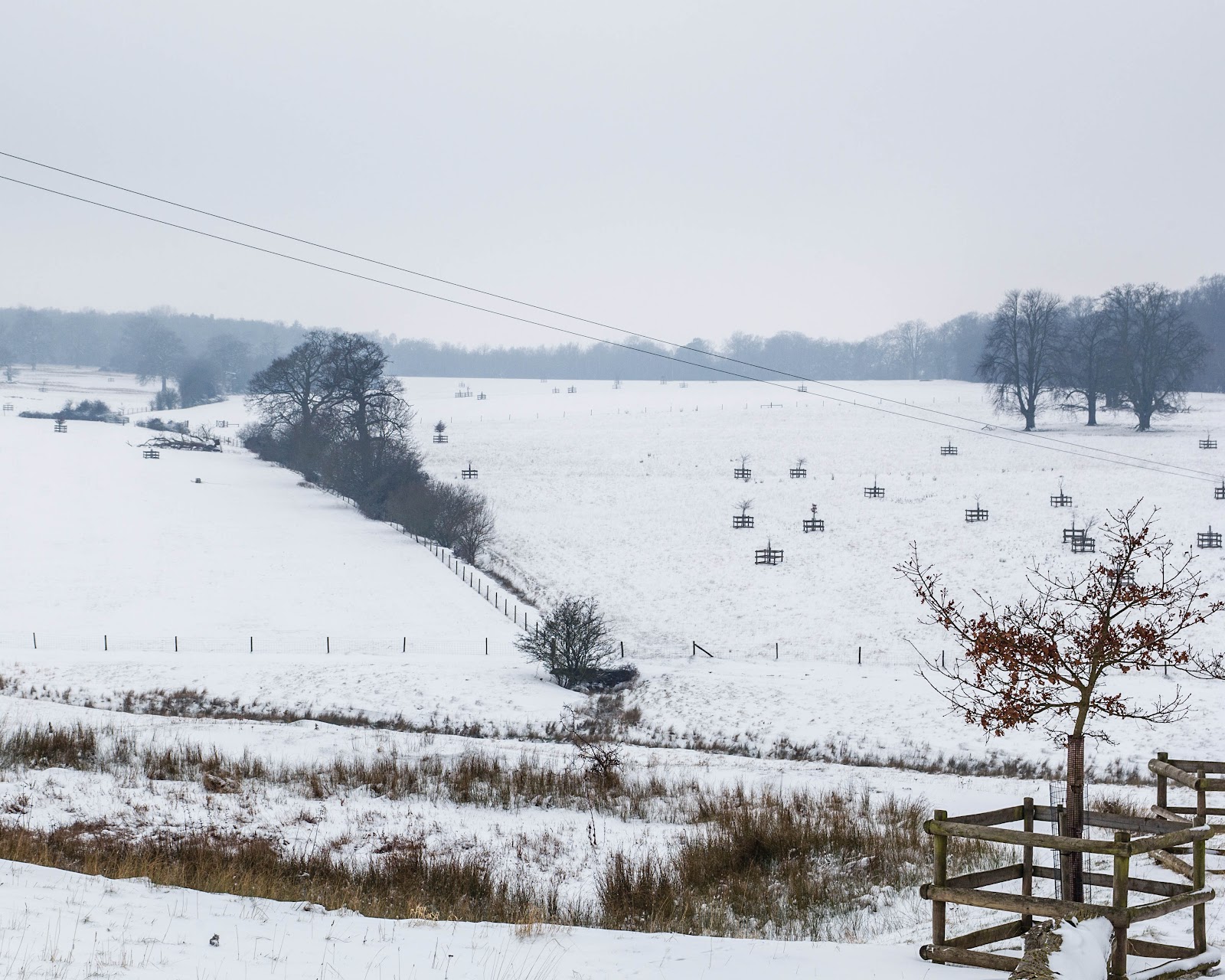
I took many more but will be using those for the winter shots for both Assignment 1 and Project 15 portfolio work.
As I said above it was an overcast day but two days later the sun shone so I include two additional shots showing the effect of sunlight. and shadows.


In the first of these two there is a bluish tinge in the shadows that is not unattractive.
As stated in the Course material the chances of snow in this Country particularly in East Anglia is small. The lessons learnt from this exercise (apart from how tiring it is trudging through 4 inches of fresh snow carrying a tripod and camera) were the delights of such photography and the sculpting effect of snow fall
on trees and shrubbery. In technical terms the advice on exposure compensation has to be approached with some caution although why this is the case is less clear to me. Fortunately I invariably shoot RAW so I have opportunity to adjust the exposure later. Although on the day the lack of sunshine made the exploration of the effect of varying light not possible in the main I was able to do so later in the week.
Subscribe to:
Posts (Atom)